Table of Contents
- Why a Polite Rejection Email Is Crucial for Your Employer Brand
- Preserving Candidate Experience
- Building a Talent Pool for Future Needs
- Legal and Ethical Considerations
- Core Elements of an Effective Rejection Email
- Subject Line That Sets the Right Expectation
- Personalized Greeting
- Expression of Gratitude
- Clear Yet Compassionate Decision Statement
- Optional Feedback or Next Steps
- Professional Closing and Signature
- Sample Polite Rejection Emails – Ready to Use
- Example 1: After a Single Interview
- Example 2: After a Multi‑Stage Process
- Example 3: When You Want to Offer Constructive Feedback
- Tips for Customizing Your Rejection Email
- Match the Tone to Your Company Culture
- Use the Candidate’s Name Throughout
- Be Specific Without Over‑Explaining
- Consider Adding a “Stay Connected” CTA
- Avoid Common Pitfalls
- Integrating Rejection Emails into Your Recruitment Workflow
- Automate With a Human Touch
- Schedule Follow‑Up Checks
- Track Metrics
Sending a rejection email to candidate politely example is one of the most delicate tasks a recruiter or hiring manager faces. While the news is inevitably disappointing for the applicant, the tone and content of your message can leave a lasting impression—either reinforcing a positive view of your organization or damaging its reputation. In today’s competitive talent market, even candidates who are not selected today may become valuable contacts tomorrow, or they may share their experience on social media, influencing future applicants. Therefore, mastering the art of a courteous rejection email is not just a courtesy; it’s a strategic move for long‑term brand equity.
In this article we will explore why respectful rejections matter, break down the essential components of an effective email, provide multiple ready‑to‑use examples, and share actionable tips for customizing each message. Whether you’re a seasoned HR professional or a small‑business owner hiring your first employee, you’ll walk away with a toolbox of language that conveys empathy, professionalism, and genuine appreciation for the candidate’s effort.
Before we dive into the specifics, it’s worth noting that a well‑crafted rejection email does more than just say “no.” It acknowledges the candidate’s time, offers constructive feedback when appropriate, and keeps the door open for future opportunities. This approach aligns with a broader recruitment philosophy that treats every applicant as a potential ambassador for your brand. If you’re curious about how external stakeholders view similar communication practices, you might find the insights from understanding the sponsor’s perspective especially relevant.
Why a Polite Rejection Email Is Crucial for Your Employer Brand
Preserving Candidate Experience
- First impressions last. Candidates often judge a company based on the entire hiring journey, from the job posting to the final email.
- Positive word‑of‑mouth. Satisfied candidates, even those rejected, are more likely to recommend your firm to peers or consider you for future roles.
- Reduced negative reviews. A courteous email can mitigate the risk of public complaints on platforms like Glassdoor or LinkedIn.
Building a Talent Pool for Future Needs
When you maintain a respectful tone, you keep high‑quality talent engaged. Many organizations maintain “talent pipelines” by staying in touch with past applicants. A polite rejection email is the first step in that ongoing relationship.
Legal and Ethical Considerations
While most jurisdictions do not require detailed feedback, providing clear, non‑discriminatory reasons when asked can protect you from potential claims of bias. A well‑written email sets a professional baseline that can be referenced if any disputes arise.
Core Elements of an Effective Rejection Email
Subject Line That Sets the Right Expectation
Keep it concise and transparent. Examples include:
- “Your Application at XYZ Corp – Update”
- “Thank You for Interviewing with ABC Ltd.”
- “Next Steps Regarding Your Application for the Marketing Role”
Personalized Greeting
Address the candidate by name and, if possible, reference the specific position they applied for. This small touch signals that the email is not a generic blast.
Expression of Gratitude
Thank the candidate for their time, effort, and interest. A genuine acknowledgment goes a long way toward softening the disappointment.
Clear Yet Compassionate Decision Statement
State the outcome directly but kindly. Avoid vague phrases like “we will keep your resume on file” unless you truly intend to do so. Ambiguity can lead to false hope.
Optional Feedback or Next Steps
If you can provide constructive feedback, do so in a brief, actionable manner. Alternatively, invite the candidate to apply for future openings that match their skill set.
Professional Closing and Signature
End with a warm sign‑off, your full name, title, and contact information. This reinforces the personal nature of the communication.
Sample Polite Rejection Emails – Ready to Use
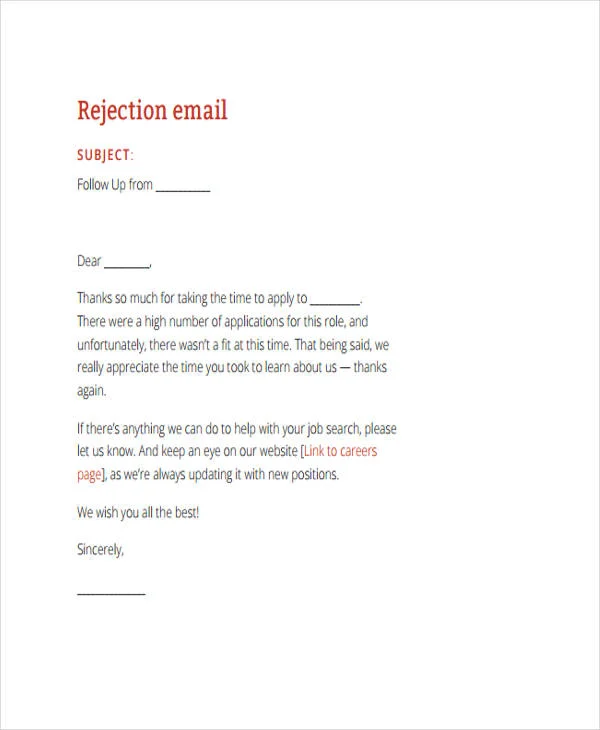
Example 1: After a Single Interview
Subject: Your Application for the Junior Analyst Position
Dear Maria,
Thank you for taking the time to interview with us for the Junior Analyst role. We were impressed by your analytical mindset and your experience with data visualization tools.
After careful consideration, we have decided to move forward with another candidate whose background more closely aligns with the immediate needs of the team. This decision was not easy, as your qualifications are strong.
We will retain your resume in our talent pool and will reach out should a future opportunity better match your skill set. In the meantime, we wish you continued success in your career.
Warm regards,
James Lee
Talent Acquisition Manager
XYZ Corp
Example 2: After a Multi‑Stage Process
Subject: Update on Your Application – Senior Software Engineer
Hi David,
First, I want to thank you for the dedication you showed throughout our rigorous interview process. Your deep knowledge of cloud architecture and your thoughtful responses to our technical challenges were truly commendable.
Unfortunately, we have selected another candidate whose experience with micro‑services migration aligns more directly with the current project timeline. Please know that this decision reflects the specific fit for this role rather than an assessment of your overall capabilities.
We would love to keep your information on file for upcoming senior engineering positions, especially those focused on AI integration, which match your expertise.
Thank you again for your interest in ABC Ltd. If you have any questions or would like feedback, feel free to reply to this email.
Best wishes,
Sofia Martinez
Head of Engineering Recruitment
ABC Ltd.
Example 3: When You Want to Offer Constructive Feedback
Subject: Thank You for Applying – Marketing Coordinator
Dear Leah,
We appreciate the effort you put into your application and the interview for the Marketing Coordinator position. Your creativity and portfolio stood out.
After a thorough review, we have chosen to move forward with a candidate whose experience includes a stronger background in email automation platforms, which is a critical component of this role at this stage.
If it would be helpful, I’m happy to share a brief note on one area that could strengthen future applications: gaining hands‑on experience with tools like Mailchimp or HubSpot. Many candidates find that a short certification adds measurable value.
Thank you again for your interest in our team. We will keep your profile in our system and encourage you to apply for future openings that align with your evolving skill set.
Sincerely,
Karen Patel
Recruitment Specialist
Creative Edge Agency
Tips for Customizing Your Rejection Email
Match the Tone to Your Company Culture
If your brand voice is casual, a friendly sign‑off like “All the best” may be appropriate. For more formal industries, stick to “Sincerely” or “Regards.” Consistency reinforces brand identity.
Use the Candidate’s Name Throughout
Repeating the name in the greeting and closing personalizes the message. Avoid generic salutations like “Dear Applicant.”
Be Specific Without Over‑Explaining
Share a concise reason (e.g., “more experience with X”) rather than a long list of deficiencies. Specificity shows you reviewed their profile, while brevity respects their time.
Consider Adding a “Stay Connected” CTA
Invite candidates to follow your company’s LinkedIn page, join a talent community, or subscribe to a newsletter. This turns a negative moment into a networking opportunity.
Avoid Common Pitfalls
- Ghosting. Never leave candidates without any response; it damages trust.
- Over‑promising. Don’t promise future contact unless you intend to follow up.
- Legal language traps. Steer clear of phrases that could be interpreted as discriminatory.
Integrating Rejection Emails into Your Recruitment Workflow

Automate With a Human Touch
Many applicant tracking systems (ATS) allow you to create email templates that can be personalized with merge fields (e.g., candidate name, position). Use automation for speed, but always review the final draft before sending.
Schedule Follow‑Up Checks
Set reminders to revisit candidates you kept on file. A brief “We have a new opening that matches your profile” email can reignite interest and reduce time‑to‑fill for future roles.
Track Metrics
Measure candidate satisfaction through post‑rejection surveys. Even a single question like “Did you find the communication clear and respectful?” can provide valuable data for continuous improvement.
By implementing these practices, you transform a routine “no” into a strategic touchpoint that supports your broader talent acquisition goals. Remember, the ultimate aim is not just to decline a candidate but to maintain a positive relationship that could benefit both parties down the line.
In summary, a polite rejection email is more than a formality; it’s a reflection of your organization’s values, a safeguard against reputational risk, and a gateway to future talent opportunities. Use the examples, templates, and tips outlined above to craft messages that are clear, compassionate, and brand‑consistent. When every candidate leaves the process feeling respected, you reinforce a culture of professionalism that resonates far beyond the hiring cycle.